Two years ago, British singer-songwriter Rebecca Lucy Taylor, who records as Self Esteem, released an album called Prioritise Pleasure. In the first verse of the opening track, “I’m Fine,” Taylor describes, over a pulsing groove, a sexual encounter that took a bad turn. “I did not consent to / still I served you / ’cause I didn’t know how not to,” she sings.
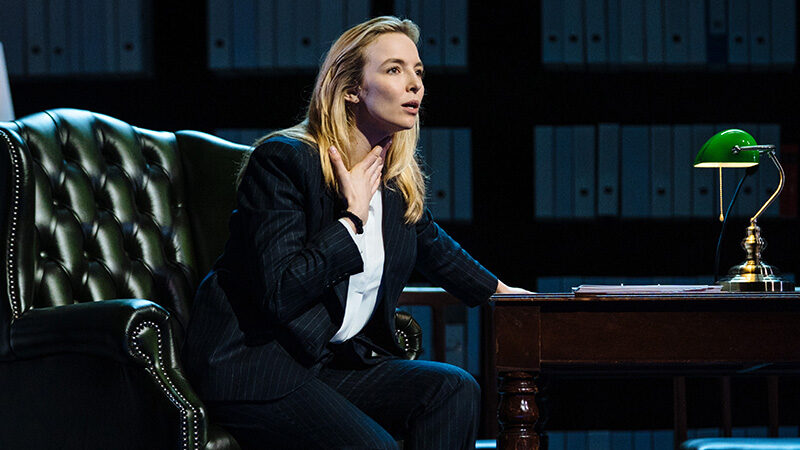
The album, which includes other songs that deal candidly (and infectiously) with women’s struggles, reaped critical acclaim and earned Taylor a growing number of fans — among them James Bierman, whose independent company Empire Street Productions is bringing Prima Facie to Broadway this spring. Written by former lawyer Suzie Miller, the one-woman play — which has already earned praise in London — focuses on a rising defense attorney who questions her work representing accused rapists after she herself is assaulted.
Bierman reached out to Taylor, and Taylor read the play. “I thought, ‘The album I just put out could have been a soundtrack for this,’” she says. So when she was asked to compose an original score for the production — which begins previews April 11 at the Golden Theatre, where it’s set to open April 23 — Taylor jumped on board.
“I see it as a continuation of Prioritise Pleasure,” Taylor says of the resulting soundtrack, which is featured in the production. “For me, to be honest, the whole of Prima Facie is kind of a continuation of ‘I’m Fine.’”
Taylor was always interested in theater, and has “been trying to make a musical for years,” she says, citing shows such as Little Shop of Horrors, A Chorus Line, and Cabaret among her favorites. (“I love anything with a little bit of darkness,” she explains.) In her youth, “I had really wanted to go to drama school, but I didn’t get in.” Instead, Taylor found a measure of success in the indie band Slow Club before branching out on her own as Self Esteem.
Taylor’s 15 years in the music business helped her relate to Prima’s heroine, Tessa Ensler — played by rising screen star Jodie Comer, reprising her U.K. performance — in a number of ways. “I’m from a town in the north of England that isn’t an amazingly fruitful place if you want to make art,” Taylor muses. Tessa, too, has a working-class background, but ascends professionally after attending an elite law school. “When you’re surrounded by privileged people, people who have the confidence and self-assurance that comes with the safety of being financially secure, it can be difficult to get yourself on that same plane.”
The specific experience that drives Tessa to seek justice also resonated with Taylor. “My songs deal with that part of me that realizes that stuff I didn’t want to happen to me has happened,” she notes. “I feel like in our conversations about women’s safety, we’re often fed a sensationalistic narrative — about people who get attacked on their way home, or kidnapped, or dragged down an alleyway. What’s not as exciting to examine in a podcast or TV drama are these systemic, constant, patriarchal assaults that are so insidious and stealth. There’s not a lot of representation of that gray area.”
In crafting her often starkly atmospheric music for Prima — electronically driven, like Self Esteem’s other recordings, but with lyrical acoustic flourishes — Taylor spoke frequently with director Justin Martin, and was provided both guidance and creative autonomy. “They blocked it out for me, told me that this needs to feel like this and this needs to feel like that,” she says. “I enjoyed having a structure to work with. But there weren’t too many set-in-stone lines when I began working on it, which I meant I had scope. They were always open to my ideas, so I never felt like a hired songwriter; it felt very collaborative.”
The biggest challenge, Taylor says, was “that I didn’t have access to a bunch of instruments to work with. But I had a really amazing producer who sat with me the whole time, and it was a testament to good communication and collaboration that we got there. I actually wound up with a lot more music than is used in the play, which is why we released it as an album.”
Taylor would still like to add a musical to her résumé at some point — “I want to write one and I want to be in one,” she enthuses — but suggests that Prima Facie has given her a uniquely rewarding experience. “The main takeaway in London was how unifying it felt for the audiences. The play is dealing with the kind of non-sensational but consistent sexual assaults that happen all the time everywhere, and while people too rarely come forward, you could feel that many of them related to it.”
She adds, “One of the things I love about this play is that there’s no happy little bow on it at the end, no saying that everything’s going to be all right — but it still makes you hold on to hope. It’s honestly uplifting to know that people with this much bravery can’t be ignored. It feels like the start of something, and that’s rare in theater.”